

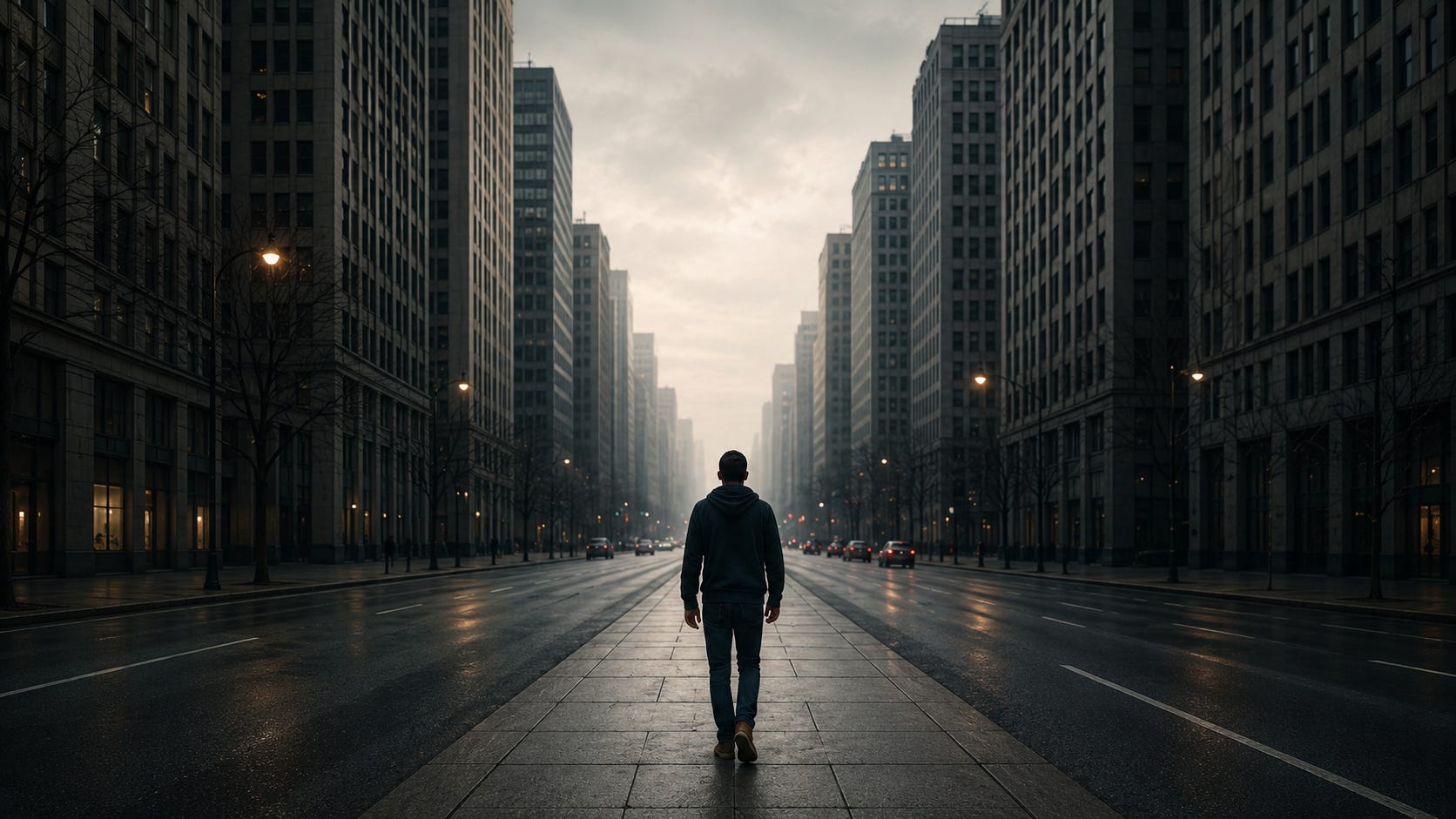
Urban loneliness is not only the pain of being alone among people, but the quiet distance that forms when we lose contact with presence, with the body, and with the living ground beneath us.
Cities promise togetherness.
They gather us by the thousands, then by the millions. They place our windows across from one another, our footsteps on the same pavements, our bodies inside the same trains, offices, elevators, cafés, waiting rooms, and crossings. From a distance, the city appears almost intimate: a vast human organism lit from within, breathing through streets and stations.
And yet many of us know the strange loneliness that lives there.
It is not always the loneliness of having no one nearby. Often, it is the opposite: the loneliness of being surrounded by people and still feeling unreached, of passing face after face without meeting anyone, of hearing voices everywhere while feeling that no voice is truly speaking to us.
There is a particular ache in this kind of life. It does not announce itself dramatically. It arrives in the walk home after a full day, when the body has been among people but the heart has not been met. It appears in the elevator mirror, in the silence after a message is sent, in the room that contains everything necessary except warmth. It appears when the city keeps moving, and something in us quietly cannot.
Urban life teaches us how to move around one another. It teaches efficiency, self-containment, speed, politeness without intimacy, contact without arrival. We learn the choreography of distance. We stand close without becoming close. We share space without sharing presence.
In urban settings, individualistic lifestyles dominate, often resulting in indifference among neighbors and a sense of social anonymity. As people focus on their own lives and routines, they may unintentionally overlook those around them, leaving others feeling isolated or unseen.
— Mindfulness for Loneliness
At some point, proximity stops feeling like connection. A crowd becomes a kind of weather. Faces become part of the background. We protect our attention because so much demands it, and slowly, almost without noticing, we begin to withhold ourselves too.
This is one of the quieter wounds of the city: not simply that it separates us from each other, but that it trains us to live as if separation were normal.
When the Ground Disappears
In the city, the earth is still there, but it is hidden beneath concrete, asphalt, stone, steel, glass, foundations, tunnels, platforms, parking lots, towers, and roads. We walk above it every day without feeling it. Our feet meet surfaces designed for passage, not belonging. The ground becomes something to cross rather than something to know.
The sky, too, becomes partial. It appears between buildings, reflected in windows, divided into rectangles by walls and roofs. Rain becomes an inconvenience. Trees become decoration, placed carefully where they will not interrupt the machinery of movement. Wind becomes something to endure between one enclosed place and another.
Slowly, the body forgets. It forgets the smell of soil after rain, the quiet intelligence of trees, the restorative depth of darkness, the fullness of silence, and the simple fact that the world is not only something to manage, cross, consume, or photograph.
And when the body forgets the living world, the inner life begins to lose a certain depth.
Not all at once, and not visibly, but in small, almost imperceptible ways. We become more reactive than receptive, more stimulated than nourished, more connected to signals than to presence. We begin to live on surfaces: pavements, screens, reflections, schedules, notifications, polished rooms, bright corridors, and the endless smoothness of things made not to hold us, but to move us along.
The loneliness that follows can be difficult to name because it does not always feel like sadness. Sometimes it feels like fatigue, restlessness, or a vague hunger that no message, purchase, achievement, or evening plan can satisfy. Something in us is looking not for more noise, more novelty, or another surface, but for contact with what feels real enough to steady us.
The Loneliness of Surfaces
Much of modern life happens without texture.
We touch glass more than bark, screens more than skin, pavement more than soil. We move through spaces that are polished, lit, optimized, measured, and controlled. Everything is made visible, but not necessarily intimate. Everything is accessible, but not necessarily near.
There is a loneliness that grows in this condition: the loneliness of being overexposed and under-met. Seen in fragments, but not received in fullness. Available, but not known. Surrounded by invitations to communicate, while rarely entering the silence in which true communication begins.
The city intensifies this. It gives us endless contact without necessarily giving us encounter. It lets us live among people whose sorrows, hopes, tenderness, and histories remain hidden behind tired eyes, closed doors, headphones, calendars, and practiced expressions.
We become strangers not only to one another, but to the subtle life within ourselves.
The inner world asks for slowness, while the city asks for speed. The inner world asks for attention, while the city scatters it. The inner world asks to feel, while the city rewards whatever can keep functioning. And so loneliness settles into the distance between the life we perform and the life we have not had time to inhabit.
This may be why urban loneliness can feel so confusing. From the outside, nothing appears missing. There are people, lights, choices, events, transport, cafés, messages, opportunities, movement. The city offers an abundance of contact. But contact is not the same as communion, movement is not the same as meaning, and visibility is not the same as being seen.
All real living is meeting.
— Martin Buber, I and Thou
A person can spend years in a city and still feel that no place has truly received them. A person can be known by many and still feel untouched. A person can move through life efficiently and still feel, somewhere beneath the surface, that they have not arrived.
The Ache Beneath the Noise
Urban loneliness often hides beneath activity.
The day fills itself before we have a chance to ask what it is filling. Work, errands, messages, obligations, plans, small negotiations, and constant movement leave little room for the deeper question of whether we are actually present inside the life we are maintaining. Even rest becomes another thing to schedule, and even silence becomes something we fill before it can reveal too much.
But the ache remains underneath.
It waits beneath productivity, beneath conversation, beneath the habits that keep life apparently intact. It waits beneath the tired answer of “I’m fine.” It waits beneath the small rituals of distraction that help us pass through the evening without touching what hurts.
This ache is not always asking to be solved. Sometimes it is asking to be heard.
Mindfulness begins there, as the slow return of attention to what the city’s speed has covered over: the breath, the body, the feet, the small tree passed every morning and never truly seen, and the grief of living in a world where so much is close and so little is felt.
Presence changes the way we inhabit what is here. Concrete remains concrete, crowds remain imperfect, and loneliness may still pass through the body; yet attention gives the inner life a place to return. Sometimes this is the beginning of another kind of belonging, one that does not wait for the world to choose us before allowing us to come home to ourselves.
The Forgotten Earth
Our disconnection from one another mirrors our disconnection from the earth.
A city is often built by covering what came before. Rivers are redirected. Soil is buried. Trees are removed, then returned as design features. Night is softened by artificial light until darkness itself feels unfamiliar. The living world is not erased completely, but it is pushed to the margins, made decorative, managed into fragments.
Something similar happens inside us.
We learn to cover what is inconvenient. We redirect grief. We manage longing. We make tenderness presentable. We cut down what grows slowly because the world prefers what can be measured quickly. We call this maturity, discipline, realism, adulthood, though sometimes it is simply another form of burial.
The buried earth does not disappear. Neither does the buried self.
Beneath the concrete, something remains alive. Beneath the roles, schedules, performances, reactions, and practiced composure, something in us still knows how to belong. It does not need applause, move at the pace of the market, or measure life only by productivity, visibility, and control. It is patient enough to wait beneath all that covers it.
To remember the earth is not only an environmental gesture. It is an inward one. It is a way of remembering the part of ourselves that still knows how to receive, how to listen, how to stand somewhere without immediately needing to leave.
This is not nostalgia for a vanished world. It is not the fantasy that life was once simple, or that every wound can be healed by trees and silence. It is something more modest and more serious: the recognition that human beings were not made to live entirely above the ground, inside abstraction, speed, and reflection.
We are not only minds moving through systems. We are bodies, breath, senses, memory, longing. We are creatures of weather, light, rhythm, touch, season, and place. When these disappear from daily life, something in us does not stop needing them. It simply grows lonely in a way language struggles to explain.
Belonging Before Words
We often think of belonging as something given by other people: to be welcomed, chosen, invited, recognized, loved. And of course, this matters deeply. Human beings are not meant to live untouched by one another. We need voices, faces, gestures, shared meals, honest conversation, and the simple warmth of being remembered.
But there is also a more ancient belonging: the belonging of being here, of having a body made from the same earth it walks upon, of breathing air exchanged with trees, of standing under the same sky as strangers whose inner lives are also hidden, complex, and tender.
The world is not merely background to our private loneliness. It is relationship.
A tree beside a road does not remove loneliness. A slower walk does not repair the architecture of modern life. A mindful breath does not replace the need for human closeness. But these small returns matter because they remind us that loneliness is not always a sign that something is wrong with us. Sometimes it is a sign that the conditions around us have made real contact difficult: contact with others, with silence, with nature, with the body, with the present moment.
And if distance has been learned over time, return can also be learned — through the patient restoration of attention to what still lives beneath the noise.
The practice begins almost invisibly. A person pauses before entering the building. A breath is felt instead of ignored. The tree on the corner stops being scenery. The stranger passing by is no longer only an obstacle. The body, after years of being used as transportation for the mind, is felt again as home.
Nothing dramatic has happened, and yet something has shifted. The world has become less flat. The self has become less absent.
Returning to the Ground
There is a kind of healing that begins before life changes on the outside.
It begins when attention comes back to the breath entering the chest, to the weight of the feet, to the tree whose leaves move without hurry, to the stranger no longer reduced to obstacle or background, and to the quiet sadness of living in places that often ask us to function more than feel.
Mindfulness offers a quieter form of attention, one that remains awake to life even inside the conditions that make us feel separate. It helps us notice what still breathes between traffic and glass, between hurry and exhaustion, between one solitary person and another.
The earth is still beneath us. The body still knows how to return. The heart still recognizes presence when it is allowed to slow down enough to feel it.
Perhaps this is where reconnection begins — not with a grand escape from the city, but with a different way of standing inside it. Less absent, less armored, less forgetful of the ground.
And maybe, as we return to the earth beneath us, we also begin to return to the life within us.
Continue the Practice
If this essay spoke to something you have been carrying, Mindfulness for Loneliness: Transforming Isolation into Inner Peace offers a more structured way to continue.
The book was written for the kind of loneliness that does not always look dramatic from the outside, but quietly changes how life feels from within: the distance from others, from the body, from meaning, from the present moment.
Inside, you will find reflections and mindfulness practices for meeting loneliness without turning away from it. Not by escaping it, not by explaining it away, and not by forcing yourself into artificial positivity, but by learning how to return to breath, presence, inner ground, and the forms of belonging still available beneath the noise.
If you are living with this kind of distance, the guide may be a steady place to continue.
📘 Mindfulness for Loneliness: Transforming Isolation into Inner Peace
Continue Reading
If this touched something familiar, these nearby essays continue the thread:


If you’d like to help sustain this space — and the wider work growing from it — you can also do so here.
This was really good. I like your take, it really signals your thinking and it's something I really appreciate. So many quotables but I really like "The world is not merely background to our private loneliness. It is relationship." It really reveals that just existing, being party to this life and all the things in it is so valuable. I could go on, I love your description of city life and how even though you're in close proximity you don't always create community and how the world can start making nature feel like an inconvenience. Super poignant work
Wow I was scared to read this but the same time could not stop. We have an epidemic of loneliness in our society but don’t want to admit it. Nice work.