

When a few take more than they need, everyone else begins to live as if there may not be enough.
The Village Table
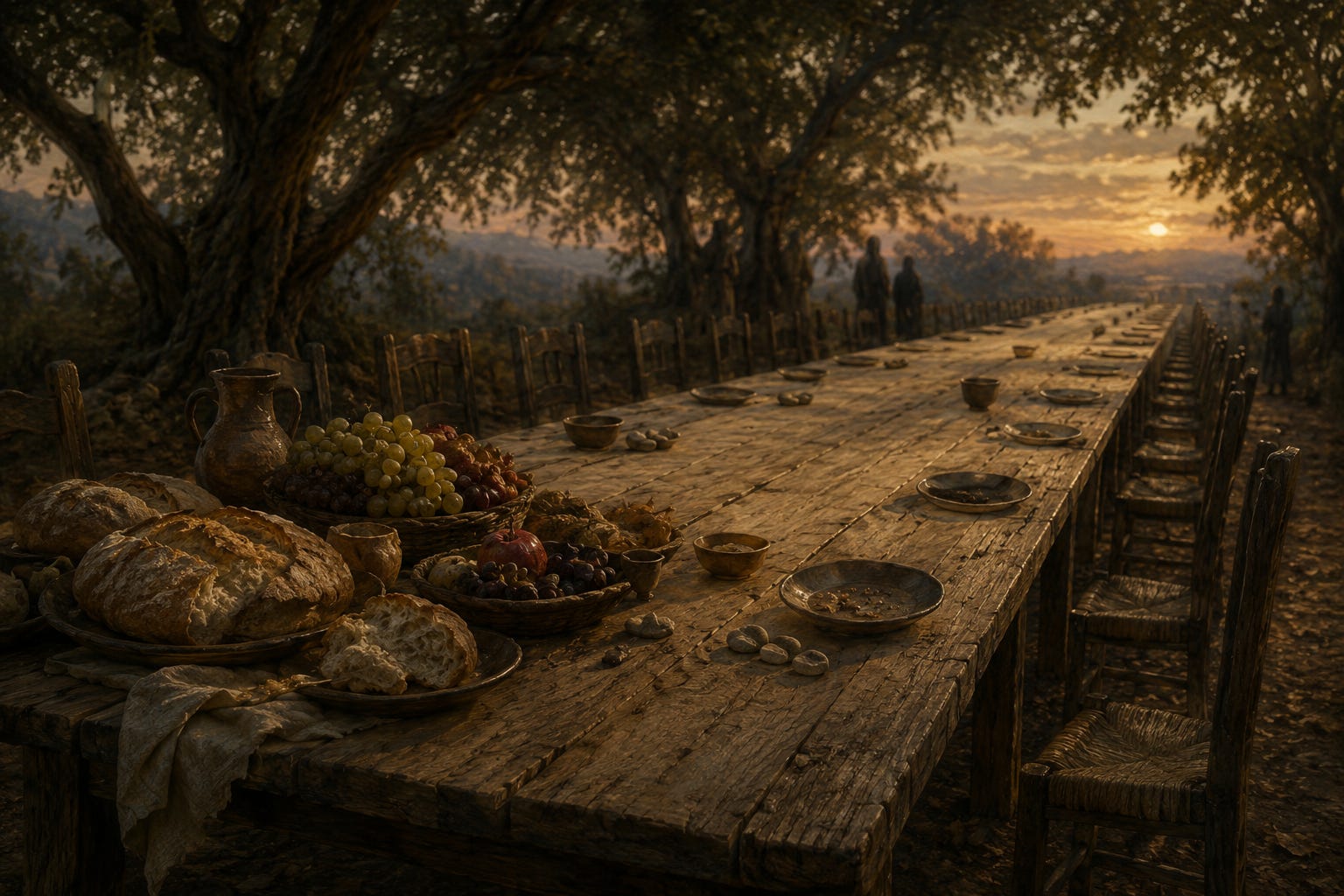
There was once a village with a long wooden table at its center.
No one remembered who built it. It had always been there, stretching beneath the trees, wide enough for every family, every child, every elder, every traveler who arrived with dust on their shoes and hunger in their eyes.
In the beginning, the table was simple.
Bread was placed in the middle. Water was passed by hand. Bowls moved from one side to the other without ceremony. No one counted too carefully, because no one had yet learned the private terror of being left with nothing.
People ate slowly then.
They spoke between mouthfuls. They noticed who had not arrived. They made room without needing to be praised for it.
The table did not make the village perfect. People still argued. Children still cried. Someone always took the last fig and pretended not to know.
But the table gave life a shape that could be trusted.
There was enough — or close enough to enough that the heart did not spend its days measuring.
When One Person Takes Too Much
Then, one evening, a man took two loaves instead of one.
No one objected at first. Perhaps he was hungrier than usual. Perhaps someone at home was waiting. Compassion is easy before patterns reveal themselves.
The next evening, he took three.
By the end of the week, he had begun arriving early with a basket.
When someone asked, gently, whether he might leave more for others, he smiled with the tired patience of a visionary misunderstood by ordinary minds.
“I am only being responsible,” he said.
It was an excellent answer. The kind people admire because it sounds practical enough to avoid being examined.
Soon, another villager began placing his chair closer to the bread. Not directly in front of it — that would have looked rude — but near enough that his arm could reach before anyone else’s hope had fully formed.
A third brought a small cloth and covered his plate.
“For hygiene,” he explained.
A fourth began offering advice to those who had less.
“You should wake earlier.”
“You should plan better.”
“You should develop a more abundant mindset.”
This last phrase became very popular among those already holding several baskets.
The New Wisdom of the Full
Within a season, the table had changed.
It was still called the village table. This mattered. Names are useful when reality becomes inconvenient.
The bread still appeared in the center, at least symbolically. The water still reflected the sky. People still gathered beneath the same trees.
If a traveler passed by quickly, they might even have said, “What a generous village. Look how long their table is.”
But those who sat there knew.
The table no longer felt like a place of meeting.
It had become a place of strategy.
People watched hands. They calculated distance. They learned how to reach quickly without seeming desperate. They learned how to smile at those with fuller plates, because resentment was considered unattractive and gratitude was always in season.
Children were taught manners, which mostly meant not asking why some plates were full before the meal began.
Greed rarely calls itself greed. It prefers cleaner names: responsibility · ambition · discipline · realism.
This is one of greed’s oldest disguises.
It does not enter the village shouting, “I intend to take more than my share.”
It arrives dressed as prudence. It carries a notebook. It explains conditions. It says the situation is complex.
And of course, the situation is complex.
Most situations become complex once someone benefits from keeping them that way.
The First Counters
After some time, the village appointed counters.
This was presented as progress.
Until then, people had simply noticed hunger. Now hunger could be recorded. The counters brought small stones and placed them beside each plate. One stone for a small portion. Two stones for a larger one. Ten stones for those whose baskets had become too important to question.
The counters were very serious people.
They did not ask whether the table felt fair. They asked whether the stones had been placed correctly.
This gave the village a new peace, or at least the appearance of one.
A person could now be hungry in a properly measured way.
A child could watch another plate overflow and be told, with great calm, that the numbers were accurate.
The counters were not cruel. Most of them believed in their work. They liked order. They liked fairness. They liked the clean dignity of a system where everything could be explained without anyone needing to look too long at a face.
And this was the strange power of counting:
It gave unevenness a costume of substance.
The full plates became figures. The empty bowls became figures. The distance between them became something to calculate, compare, interpret, and debate.
Once something is measured, people often assume it has been justified.
A person with ten stones no longer looked like someone taking more than others needed. He looked established. A person with one stone no longer looked like someone deprived of a share. He looked behind.
This is how a village begins to confuse record-keeping with truth.
A number can describe an injustice so neatly that, for a moment, no one has to feel it.
The Lessons That Kept the Table Still
But numbers alone were not enough.
For the new order to last, people had to learn how to explain it to themselves.
So the village began teaching small lessons. Not formally. Not with banners or decrees. The most effective teachings rarely announce themselves. They enter through advice, jokes, warnings, common sense.
Those with little were told to work harder.
Those who were tired were told to be grateful.
Those who questioned the baskets were told they did not understand how the table worked.
Those who still dreamed of a different arrangement were told to grow up.
“You have to be realistic,” the elders said, though many of them only meant, “Please do not disturb the arrangement I have survived.”
“Everyone has the same chance,” said the man seated closest to the bread, while resting one hand on the basket he had arrived early to fill.
“If you want more, earn more,” said another, who had quietly inherited three chairs and a favorable position near the center.
And slowly, the village learned to mistake repetition for wisdom.
The same phrases passed from mouth to mouth until they no longer sounded like opinions. They sounded like weather.
Work harder.
Stop complaining.
Be practical.
Give up the dream.
This is how life is.
These sentences did not need to be true to be powerful.
They only needed to be repeated often enough that people began to say them to themselves.
A system becomes strongest when the people shaped by it begin to defend it from within.
This was the deeper success of the table’s new order.
Not that a few had taken too much.
That part was simple.
The deeper success was that many began to believe the taking was natural. Some even began to protect it, not because they were cruel, but because questioning it would make their own lives tremble.
A quiet life can become its own kind of bargain.
Do not ask too much.
Do not see too clearly.
Do not disturb the people with baskets.
Keep your head down, and perhaps your portion will remain.
This is how inequality learns to breathe through ordinary people.
Not only through greed at the top, but through fear in the middle. Through resignation below. Through the small private agreement to stop imagining anything else.
The table did not need everyone to be greedy.
It only needed enough people to be unconscious, tired, afraid, or comfortable.
And so the arrangement held.
The People Around the Baskets
The man with the largest basket did not sit alone for long.
At first, people watched him with discomfort. Then a few began moving closer.
Not close enough to appear dependent. Not far enough to lose advantage.
They praised his discipline. They laughed at his jokes. They learned which opinions made him generous and which questions made him cold.
Some hoped to receive a crumb. Some hoped to be invited near the basket. Some simply wanted to stand close enough to power that others would mistake proximity for worth.
Soon, the man no longer needed to defend his place by himself.
Others did it for him.
As the basket grew, the man himself became harder to approach.
In the beginning, someone could still ask him a question directly. Later, one had to pass through those seated near him — the explainers, the admirers, the careful translators of his appetite into respectable language.
They said he was busy.
They said he was misunderstood.
They said people did not appreciate how much pressure came with carrying such a large basket.
Over time, his distance became part of his importance. The less reachable he became, the more people treated him as if he must be seeing something others could not.
This, too, was useful.
A man who no longer has to answer the table can become a model for it.
Children were told to study his discipline. Young men were told to imitate his hunger. The tired were told that if they worked hard enough, perhaps one day they too could sit behind a basket large enough to require interpreters.
And so the village learned to admire the very distance that had wounded it.
The ones near him became his shield. They softened his greed into strategy, his indifference into focus, his excess into proof of vision.
By then, he hardly needed to speak.
Others had learned to speak for him.
When someone questioned the basket, a neighbor quickly explained that envy was unbecoming.
When a child asked why one person needed so much, an uncle coughed loudly and changed the subject.
When a tired woman said the table no longer felt fair, several people reminded her that fairness was complicated and that gratitude was healthier.
The greedy rarely need to defend themselves forever.
They only need enough people around them willing to do it on their behalf.
Power becomes easier to keep when those near it begin guarding the door.
Silence became useful.
It kept invitations open. It kept portions stable. It kept the powerful comfortable. It allowed decent people to avoid discovering what their decency would cost.
Over time, the silent became the guards of the system.
Not with weapons. Not with orders. Not even always with belief.
With politeness. With hesitation. With “now is not the time.” With “that’s just how things are.” With the small social punishments reserved for anyone who names what everyone has learned to survive.
A system does not need everyone to love it. It only needs enough people to protect the comfort they have found inside it.
And so the basket remained.
Not because no one saw it.
Because too many people had learned to live around it.
The Quarrels Beside the Empty Plates
As the baskets grew larger, the villagers did not only grow distant from the man who held them.
They grew suspicious of one another.
Those with nearly empty plates began watching those with slightly fuller ones. Those with one extra piece of bread began guarding it from those with none. The tired argued with the tired. The hungry corrected the hungry. The ones farthest from the basket learned to measure themselves against those only a little nearer.
This was useful.
As long as people argued across the lower end of the table, fewer eyes turned toward the baskets.
When someone asked why so much had gathered near one end, another quickly answered, “At least you have more than I do.”
When someone said the table felt unfair, someone else replied, “You only say that because you are jealous.”
When a dreamer wondered whether the table could be arranged differently, the practical ones sighed and called him childish.
The village had learned one of the oldest habits of scarcity: to turn pain sideways.
The insult moved sideways.
The suspicion moved sideways.
The shame moved sideways.
But the bread did not.
The saddest part was not only that people argued.
It was that the honest could no longer easily find one another.
Those who felt the wrongness of the table often felt it alone. One person saw it in the morning, another at dusk, another while pretending not to notice. But each had learned to be careful. Each had watched what happened to those who spoke too clearly.
So their recognition remained private.
A glance across the table.
A pause before answering.
A sentence swallowed before it became dangerous.
The arrangement did not need to destroy honesty completely.
It only needed to keep honest people uncertain of each other.
As long as the gentle believed they were alone, they stayed quiet. As long as the tired doubted whether others saw what they saw, they kept their heads down. As long as each person mistook their own unease for a private weakness, the table remained undisturbed.
This, too, was useful.
A village does not need all its people to be loyal to the arrangement.
It only needs those who doubt it to remain separated.
This is how inequality protects itself: it turns pain sideways, keeps the honest uncertain of one another, and teaches those below the basket to quarrel instead of gather.
The Children Near the Bread
Then came the children born beside the baskets.
They had not taken the first loaves.
They had not arrived early with the first basket.
They had not watched the table before it changed.
They were born after the baskets had become part of the furniture of the table.
To them, the best chairs were not advantages. They were home.
The fullest plates were not excess. They were normal.
The short distance between their hands and the bread did not feel like privilege. It felt like the natural shape of the table.
This is how entitlement often begins: not as cruelty, but as inheritance without memory.
A child raised beside the basket does not easily understand why others speak of distance. From where he sits, the bread has always been near. The table has always seemed fair enough. The hungry have always looked impatient, dramatic, or poorly advised.
Later, when he grows older, he may speak sincerely about effort.
He may say, with real conviction, that everyone should learn to reach.
He may believe this completely.
Because no one told him that his arm had always been closer.
Entitlement is not always arrogance. Sometimes it is advantage that has forgotten its own history.
A Crowded Table Can Still Be Lonely
The old women noticed first.
They noticed how conversation thinned. How laughter came later, if it came at all. How people began chewing with one eye open.
They noticed how hunger changed posture.
A person who fears there may not be enough does not sit the same way. The shoulders rise slightly. The hand stays closer to the plate. The body becomes a small border.
No decree had been issued. No soldier had arrived. No one had announced the end of trust.
And yet, trust had quietly left the table.
Everyone was still together. Everyone still came to the table. Everyone still knew one another’s names.
But something between them had tightened.
They spoke carefully. They smiled without relaxing. They learned to hide the size of their hunger, because hunger had become embarrassing. They learned to pretend they were full, because admitting need gave others information.
There can be noise, movement, opportunity, conversation, even comfort — and still a quiet absence beneath it all.
The absence of ease.
The absence of trust.
The absence of the feeling that life is not something we must constantly defend ourselves against.
The village did not become lonely because people disappeared. It became lonely because trust did.
This is the loneliness greed leaves behind.
Not dramatic. Not always visible. Not easy to name.
Just a slow tightening of the inner life.
A person may still be surrounded. Still employed. Still informed. Still reachable. Still performing the small rituals of ordinary life.
And yet something inside remains braced.
Will there be enough for me, or must I become harder to survive?
Not because they are weak.
Because they have learned, quietly and repeatedly, that the world around them is arranged by appetites larger than care.
A world shaped by greed does not only produce inequality. It produces guarded people.
What Awareness Can Still Notice
Awareness does not solve this in the simple way we might wish.
It does not redistribute the bread. It does not make exploitative systems tender. It does not ask the hungry to breathe politely through unfairness.
But awareness can still matter.
It can interrupt the spell that makes an arrangement feel natural simply because it has lasted a long time.
It can help us notice where the logic of the table has entered us.
Where have we mistaken numbers for truth?
Where have we repeated the old instructions — work harder, be realistic, stop dreaming — without asking who benefits when people believe them?
Where have we stayed silent because silence protected our portion?
Where have we accepted closeness without trust as normal?
These are not small questions.
They ask us to see that greed is not only out there, belonging to obvious villains with polished shoes and excellent explanations.
It also leaves traces in ordinary hearts.
In the impulse to compare. In the fear of giving. In the suspicion of those who ask for more. In the comfort of not seeing too clearly. In the private relief of being less exposed than someone else.
The point is not to condemn ourselves.
The point is to wake up before the table teaches us to become what wounded us.
We do not become free from greed by pretending we are untouched by it. We begin by noticing where its logic has entered us.
Enoughness as Quiet Resistance
There is a kind of enoughness that begins quietly.
It does not deny material need. It does not romanticize poverty or ask the hungry to be spiritually elegant about their hunger.
It simply refuses to let greed define reality completely.
Enoughness begins when the hand loosens.
When we notice the person across from us again. When we pass something without making it a performance. When we stop admiring accumulation as if it were depth. When we remember that a life spent guarding the plate is not the same as being fed.
Enoughness is not passivity. It is the refusal to let appetite become our only intelligence.
Perhaps the village table was never lost all at once.
Perhaps it disappeared each time someone took more than they needed and called it wisdom.
And perhaps it returns the same way.
Not through grand declarations, but through small acts of restored trust: a slower reach, a shared cup, a chair moved back to make room, a moment of seeing hunger without turning it into judgment.
Enoughness does not ask us to ignore what is broken.
It asks us not to become broken in the same shape.
Returning to the Table
The table does not need to be perfect to become human again.
But it does need people who remember what it was for.
Not conquest. Not display. Not the lonely victory of being the fullest person among the unfed.
The table was made so that life could be shared.
And somewhere beneath all our guardedness, we still know this.
We know that no one is truly nourished by a meal that teaches everyone else to fear.
We know that greed can fill a plate and empty a village.
We know that a world arranged around taking will always produce lonely people — even among those who have taken the most.
The table had never become smaller.
People had only learned to sit as if it had.
Because the soul does not live by possession.
It lives by relation.
And relation begins again wherever one person looks across the table and remembers:
There was supposed to be room for all of us.
Further Inward
If this reflection touched something familiar — the guardedness, the quiet scarcity, the feeling of living near others without feeling fully at ease — The Inner Room continues from the inner side of the same question: where loneliness gathers when life teaches us to perform, compare, withdraw, or remain unmet.
For readers who want to stay longer with these themes, Mindfulness for Loneliness is also available — not as a solution to what has been named here, but as a companion for returning to the parts of ourselves the world often teaches us to leave unattended.


Very good article, thank you Federico! I appreciate the idea of making a short story, a parable, an apologue. I suggest you should keep trying for more similar content if you want.
The village table seems to me like the "global village" we so often hear about, it does represent the world's problems of greed, injustice in general grows slowly and are easily accepted or not discussed. Your style is very effective and the content is easy to appreciate. There is room for hope, but as you states we must not "let greed define reality completely" and, I add, being aware that the table can come back as it was at the beginning of the tale. It was not a perfect table, as the apologue notices, but it was a "livable" table,
Love the metaphor and points of reflection applied to so many aspects of life