

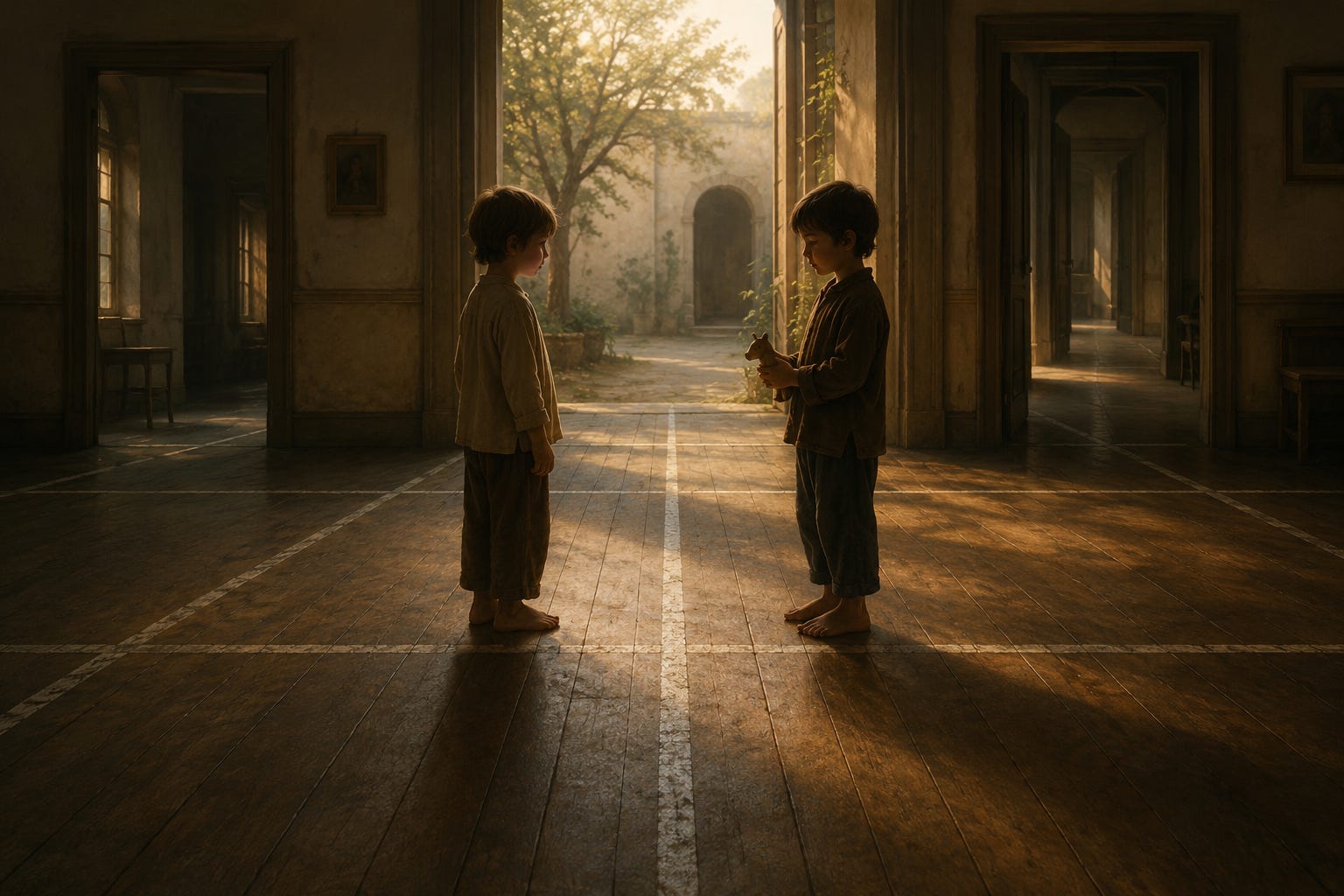
Some lines are drawn to protect tenderness. Others survive by teaching the soul where recognition must end.
Not There
Imagine a house where the lines were painted before anyone living there could remember why.
Some were pale and almost tender, visible only when morning light crossed the floor. Others were dark enough to stop a child mid-step. They passed beneath doors, circled tables, crossed thresholds, and continued into distant rooms, as if the house itself had been born from separation.
At first, the youngest children thought they were decoration. They crossed them without fear. They sat where there was warmth. They reached for whatever hand was nearest. No one had yet taught them that nearness could be forbidden.
Then, one day, a child stepped across a line near the courtyard.
On the other side, another child stood holding a small wooden animal, turning it slowly in his hands as if it carried a secret. For a moment, the two looked at each other with the simple curiosity that comes before categories.
Then an adult placed a hand on the first child’s shoulder and said gently:
Not there.
It was not shouted. It was not cruel. That was why it entered so deeply. A harsh command can be resisted. A soft correction can become part of the body.
The other child lowered his eyes. The wooden animal disappeared into his pocket. Nothing terrible happened. No door slammed. No one wept.
Only a small possibility closed.
Many forms of loneliness begin like that: not as a wound large enough to announce itself, but as a meeting that never happens.
Learning the House
As the children grew, they learned the lines were not merely lines. One was called family. Another, stranger. One was called country. Another, elsewhere. There were lines for whose grief was honored, and whose grief became background noise — lines later given respectable names: nationality, race, class, religion.
But underneath them, the lesson was often the same: this life is near, that life is far.
The adults never said, we painted this. They said, this is how the house is. This was the house’s great talent — making fresh paint look ancient. It is a useful talent. A wall you built yesterday asks to be defended. A wall that has “always been there” merely asks to be obeyed — and obedience, conveniently, requires no one to hold a brush.
A house of separate rooms is also a house that never has to answer to one voice. Each room can be told its own story. Each room can be taught that its scarcity is the fault of the room next door, and not of however the house chooses to divide what it has. A person convinced that the danger is across the floor rarely thinks to ask who benefits from keeping them looking that direction.
The house was never empty. It was full of voices, footsteps, meals, doors opening and closing. From the outside it might have looked like a place of togetherness. But everyone had learned the lines. Before a person was met, they were placed. Before their face was seen, their side of the floor had already spoken for them.
This is how loneliness can grow without solitude. It does not always begin with abandonment. Sometimes it begins with instruction — the repeated lesson that some lives are close and others distant, some voices familiar and others foreign.
The world becomes legible, but less alive. We know where everything belongs, and slowly forget how to belong to one another.
When Lines Become Walls
Not all lines are the same, and this must be said carefully.
A person may need a door. A home may need a threshold. A self may need shape. Some boundaries protect what is tender.
But a boundary is not the same as a border. A boundary can say, this is where care must be honored. A border too often says, this is where your humanity must be proven.
The loneliness begins there — when a line made by human hands is treated like a law of the soul, when a distinction hardens into an emotional command, when the heart is trained to stop recognizing life beyond a certain point.
There are borders drawn on maps, and borders drawn inside language. Borders around nations, and borders around what a family allows itself to feel.
At first, identity can feel like belonging — a name, a place, a story, a people. But when identity becomes a wall, it doesn’t deepen belonging. It narrows recognition. We stop asking who is this person and start asking which side are they on. Something human is lost before the encounter even begins.
Difference is real. Separation is taught. A line may name a difference. It does not have to become a wall.
In the courtyard, the boy with the wooden animal had stopped expecting anyone to cross back. He kept the toy in his pocket now, out of habit more than fear. He had learned the shape of the room he was allowed to stand in, and mistaken it, slowly, for the shape of himself.
The Country Room
Every house, even one this large, has an outer wall. And in that wall, there was a gate — the place where the house finally met the rest of the world, where its own lines stopped pretending to be merely domestic and became something a stranger could be stopped at. Here the lines were guarded most seriously of all: desks, stamps, flags, waiting rooms, narrow windows where a person’s face became less important than the paper held beneath it.
People approached carrying proof: proof of origin, of purpose, of return — proof they were not too poor, too desperate, too likely to remain. A person could prove almost anything about themselves except the one thing the gate actually wanted to know, which was never written on any form: whether they were near enough to matter. Some passed through because their documents carried the right history. Others stood outside because the house had decided they were born on the wrong side of permission.
The gate never asked whether they loved, or grieved, or what loneliness had followed them this far. It asked where they were from. Often, that was enough.
This is the quiet violence of political borders: they turn the place where a life began into a verdict on where recognition may begin. The house called it security. It is a fine word. It says nothing about who is kept secure, or from what, or at whose expense — which may be the whole point of choosing it. Underneath that language, something more intimate was being trained: the belief that a human being can be foreign to the world.
A house with a well-guarded gate still needs its inner rooms kept apart from one another, and a divided house is easier to govern. Room can be set against room, fear given a face, loneliness taught to blame the nearest stranger instead of the coldness of the house itself. When people stay behind their lines, they rarely ask who built the house this way. They look across the floor instead, and mistake the person there for the cause of their ache — and the house, for its part, is never short of someone willing to repaint a line and call it heritage.
A divided house is easier to govern, but harder to inhabit.
The Border Within
Over time, the house didn’t need to correct anyone anymore. Its lessons had entered the body — the pause before speaking, the instinct to stay on the permitted side. No one had to watch the door once the watching was done from the inside. This is the quietest form of control, and the most complete: not the line that is enforced, but the line a person learns to enforce upon themselves, long after anyone is checking.
A person could leave the rooms, cross seas, learn new languages, change the view from the window, and still carry the old architecture inside. There would be a place for the acceptable self, the useful self, the self that knew how to smile at the right moment. And there would be the places kept closed: the frightened self, the needy self, the lonely self — the child who still wanted to cross the floor before anyone explained what the floor meant.
What begins as a border between people becomes a border between parts of the self. The part that performs may stay. The part that grieves must wait. A person becomes a house of internal borders, moving carefully through their own life, afraid to cross into the rooms where truth has been left alone.
And then we wonder why connection feels difficult. Why closeness unsettles us. Why tenderness has to pass through so many checkpoints before it reaches another person.
The deepest borders are not always guarded by soldiers. Some are guarded by shame. Some by habit. Some by politeness.
Perhaps loneliness is not only the absence of company. Perhaps it is the ache of a life divided too many times.
Paint, Not Stone
One day, someone kneels beside one of the old lines — not in rebellion, not with certainty, only with the tired curiosity of a person who can no longer keep obeying what has never been questioned.
The person touches the line with a hand. For a moment, nothing happens. Then a faint mark comes away on the fingers.
Paint. Not stone. Not law. Not the voice of the house itself.
No one is free all at once. Some revelations arrive too quietly for triumph — only the small trace of color on the skin, and the sudden understanding that much of a life can be arranged around something made by human hands.
Mindfulness often begins this way. A breath is noticed. A reaction is seen before it becomes obedience. The body pauses at an old line, and for the first time, attention arrives before inheritance.
Nothing needs to disappear for something to change. The line may still be there. The difference may still be real. But the spell weakens. Presence doesn’t make political borders sacred — it helps us see how often they have trained the heart to confuse separation with safety.
Where Recognition Begins
No one needs to erase tenderness to begin again. A person can still have a door. A self can still have a shape.
And then, somewhere in the courtyard of the old story, the child with the wooden animal is still standing there — not because time has failed to move, but because some moments wait inside us until we are ready to meet them differently.
He is older now, in the way a person can be older without having grown. The line at his feet has faded in places, the way old paint does, but he has never tested whether it still holds.
This time, no voice arrives quickly enough to say not there.
The first child steps across the line.
It is a small thing, a single step, and yet the body remembers what the body was taught, and for a moment something in the chest tightens, waiting for the hand on the shoulder, the gentle word, the old correction. None comes. Only the quiet of the courtyard, and the sound of one foot finding the other side of the floor.
Not to prove anything. Not to perform kindness. Only because something living has, at last, become more important than the old instruction.
The other child looks up. For a long moment neither of them speaks. It is not the silence of strangers. It is the older silence — the one that was there before the line was painted, before anyone said not there, before two children became a side each.
Then, slowly, the child with the wooden animal opens his hand.
The small creature rests in his palm, worn smooth from being held so long, so privately, by someone who was never asked to share it. It is not much. It was never much. But it had been kept — through all the years of standing in his allowed room — as if some part of him had refused to fully believe the line was real.
The first child understands, in that small opened hand, everything that was lost on the day the line first separated them. Not an argument. Not an idea. Not a position in the world.
A friendship that might have lasted. A tenderness that never had the chance to become familiar. A whole stretch of years that might have been less alone.
This is what borders take first — not peace in the grand sense, not unity as a beautiful word, but the small, ordinary nearness from which everything else might have grown. A hand not reached for. A name never asked. A silence mistaken, for far too long, for distance.
The house never apologizes. Houses rarely do.
But the children sit together anyway, on the worn floor, on either edge of a line that no longer means what it once meant. And in that quiet act — nothing more than two people choosing to stay close — something older than the line returns.
Not victory. Not purity. Only recognition.
A line may be called a border, or a family, or a faith, or a self. It may carry a flag, a surname, a scripture, or a wound. Whatever name it is given, it can still only tell us where someone’s power stops.
It was never able to tell the soul where recognition must end.
If something in this reflection felt familiar — the guarded rooms, the old thresholds, the parts of yourself still waiting to be met — Mindfulness for Loneliness offers a gentle guide for the distances we carry within us. It doesn’t ask loneliness to disappear. It helps us listen more closely to what separation has left behind.


This was a remarkable piece of writing. What impressed me most was the discipline of the structure. You introduced one central metaphor and trusted it to carry the entire essay, never feeling the need to over-explain it. That takes confidence as a writer.
I also admired the rhythm of the prose. Certain images: the painted lines, the house, and especially the two children, returned throughout the piece, giving it the feeling of a carefully composed literary work rather than a conventional essay.
My favourite aspect was the ending. Bringing the story back to the children made the conclusion feel both inevitable and emotionally satisfying. It tied together everything that came before without relying on a dramatic twist.
Whether or not reader agree with every idea, it’s difficult not to admire the craftsmanship behind the writing. Thank you for sharing such an ambitious and beautifully structured essay.
you wrote some lines that have so much of impact. this will stay with me — A divided house is easier to govern, but harder to inhabit. thanks so much for writing it!