

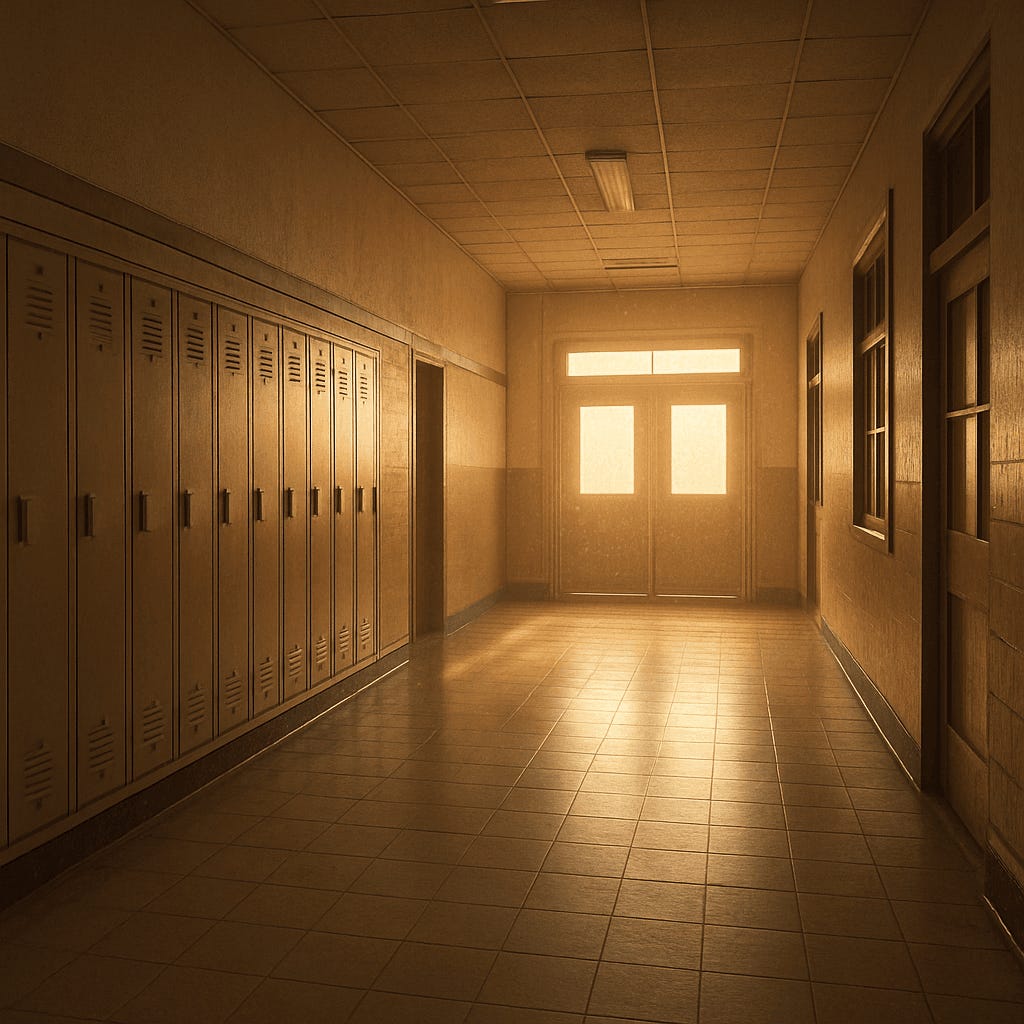
Loneliness does not come with us into the world.
It arrives slowly — taught, absorbed, repeated —
until one day it begins to feel natural.
Every newborn enters as connection itself:
soft, open, sensing, unguarded.
Loneliness is not who we are.
It’s who we learned to be.
🎒 Lesson One: School and the Art of Shrinking
Long before we learned to hide our feelings,
we learned to raise our hands.
The neat rows.
The permission to speak.
The quiet comparison between desks.
The early discovery that some parts of us fit the system —
and some must be tucked away.
We absorbed an unspoken syllabus:
Be correct.
Be composed.
Be efficient.
Be small.
A child’s inner world is wide and wild.
School asks it to narrow.
This is where many of us first learned the art of shrinking — not because anyone meant harm, but because the world prefers people who take up less inner space.
🧃 The Hidden Curriculum
Beyond subjects and exams lived the deeper lessons:
Obedience before understanding
Performance before presence
Comparison before curiosity
Silence before truth
We learned to look outside ourselves for approval.
We learned to correct ourselves before listening to ourselves.
We learned that we are allowed some emotions and must exile others.
These lessons entered the body quietly and stayed.
🌦️ The Emotions We Were Allowed to Keep
Children feel everything.
They sense before they speak.
They know without being told.
But many feelings did not fit the rhythm of the day.
So we learned to dim:
the tremor of fear,
the swell of grief,
the flicker of frustration,
the softness of longing.
We called this growth.
It was survival.
The soul doesn’t vanish when muted — it simply waits in a quieter room.
📎 Lesson Two: The Workplace as the Adult Classroom
Later, the classroom becomes an office.
The syllabus becomes metrics.
The rows become deadlines, calendars, KPIs.
We are taught, again, to trade depth for function.
To be:
agreeable when we feel overwhelmed,
productive when we feel empty,
composed when we feel human.
The inner world is asked to wait once more — this time not as a child being instructed, but as an adult being measured.
And loneliness settles into the spaces where our real self must stay silent to keep everything moving.
🧩 Lesson Three: Society and the Marketplace of Identities
Beyond the workplace, the sorting grows more intricate.
We are divided by:
nation,
tribe,
role,
belief,
preference,
algorithm,
expectation.
The categories multiply,
but their effect does not change:
the self grows distant.
We begin to speak in us and them.
We mistake labels for belonging.
We confuse conformity with connection.
Groups become islands.
Roles become masks.
Emotion becomes private.
Loneliness becomes structural.
In some places, separation appears as competition; in others, as conformity — either way, the self grows quiet.
Much of our loneliness comes from the conditioning we never noticed —
the quiet training to stay within familiar circles
and to shrink around those who feel different.
Over time, these separations become normal.
We compete more than we collaborate.
We compare more than we understand.
The result is subtle but powerful: people begin to stand apart rather than together.
Not because anyone explicitly demanded it, but because countless small signals gently guided us in that direction.
And when separation becomes ordinary, something else quietly fades — our sense that we belong to one another.
🧊 Loneliness Is Not Personal Failure
Loneliness is not the absence of people.
It is the absence of permission to be whole.
A distance shaped into us:
by countries that call strangers people who feel just like us,
by markets that prefer us chasing something,
by roles that reward outer stability and punish inner truth,
by cultures that divide, define, and demand.
If closeness feels unfamiliar, it is because the world trained us into distance.
But distance is not destiny.
It is a habit.
And habits can be unlearned.
🌀 The Frequencies We Are Shaped Into
Across our lives, certain emotional tones repeat:
urgency,
comparison,
doubt,
vigilance.
These are not random experiences.
They are echoes of a system that taught us to monitor the world more than we listen to ourselves.
When attention vibrates at low frequencies, we forget our own softness.
We forget our own voice.
We forget we were once whole.
Mindfulness doesn’t fight these patterns.
It tunes us back into ourselves.
🌿 Returning to the Inner Classroom
Silence teaches what school never did.
Sit.
Breathe.
Witness.
In the stillness, the self we muted long ago steps forward — gently, patiently, without judgment.
We begin to remember:
intuition is a kind of knowing,
emotion is a form of truth,
belonging is not earned,
connection is not rare,
we were never meant to disappear.
Mindfulness is not striving.
It is returning.
🌌 The Knowledge We Were Denied
This is the knowledge that grows in quiet hours:
sensing what is true without asking permission,
recognizing your needs before the world labels them,
letting tenderness take up space,
stepping back into the body you left years ago,
feeling your own life from the inside.
This knowledge doesn’t make you more productive.
It makes you real.
🔥 The Self You Misplaced Is Still Here
The child who felt everything,
the adult who learned to shrink,
the self beneath the categories and expectations —
They all carry the same heartbeat.
When you sit long enough,
layers loosen.
Walls soften.
A forgotten warmth returns.
You do not find a new self.
You meet the one who has been waiting, quietly, beneath all the shaping.
You were not born lonely.
You were shaped into separation.
And you can shape your way back.
If This Feels Familiar
If this reflection speaks to something you’ve long felt — that loneliness is not simply personal, but something shaped into us through pressure, performance, and disconnection from our deeper nature — Mindfulness for Loneliness: Transforming Isolation into Inner Peace offers a grounded way to meet that experience more directly.
Through mindfulness, reflection, and simple practices, it helps you understand loneliness more clearly, stay with it differently, and begin returning to the part of yourself that was never meant to disappear.
📘 Mindfulness for Loneliness: Transforming Isolation into Inner Peace
Continue Reading
If this touched something familiar, these nearby essays continue the thread:


If you’d like to help sustain this space — and the wider work growing from it — you can also do so here.
It's helpful!
interesting! i'd like to propose that the individualism that leads to separation can lead to the 'death' of the self. because people are to busy avoiding being like the others that they fail to nurture their self