

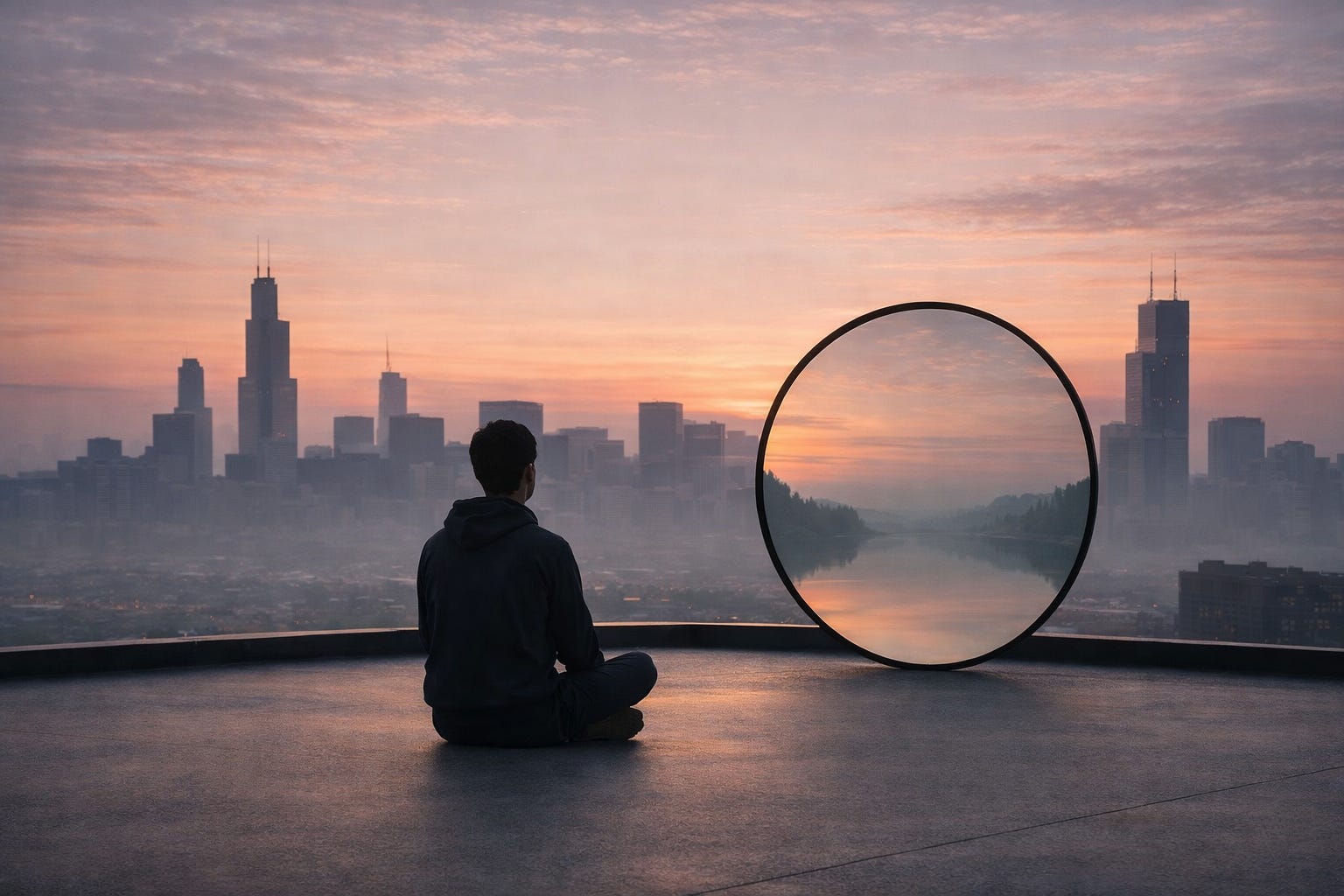
🪞 Why a Mirror?
A mirror shows what is present, and what is smudged. Attention works in the same way.
What we attend to grows vivid. What we ignore fades. The field of attention reflects the world back to us — and just as quietly, it reflects us back to ourselves: our moods, our beliefs, our fears, our loves.
If the glass is clear, the image is faithful. If it is fogged by haste, comparison, or fear, the image distorts. Over time, we begin to live for the reflection instead of the life that casts it.
Mindfulness turns the mirror back toward truth. Not to admire an image, but to meet the one who is looking.
We forgot the mirror because we turned it outward — toward metrics, audiences, and noise.
Because noise drew applause while stillness drew none.
Because we learned to perform before we learned to listen.
Because attention was traded, and something quieter was left unattended.
The Age of Distraction
We live in a culture that measures worth by visibility and motion. The louder we are, the more we are seen. The busier we are, the more we are praised.
Somewhere beneath the pace, a question lingers: when was the last time we truly listened — not to others, but to ourselves?
Digital communication has transformed how we interact, offering instant connectivity across distances, yet it often leaves connections emotionally distant.
The screen is a mirror that faces outward. It reflects what will be rewarded, not what is real. We scroll and call it connection, but meet fragments — the polished, the filtered, the carefully revealed.
The image sharpens as presence thins. Mindfulness does not reject the image; it softens the gaze behind it, allowing us to look through rather than only at what is shown.
The Market of Selves
We are told to be ourselves, and also to brand ourselves — to stand out, and to fit in.
In this marketplace, even sincerity can become performance. Left unchecked, the attention economy trains certain habits: to display, to compare, to seek confirmation before we feel.
No diagnosis is required; the posture is learned.
When the mirror faces the crowd, we disappear into our own reflection. When it turns inward, something simpler returns — unguarded, ordinary, quietly alive.
When Reflection Becomes Resistance
True introspection is slow — and slowness unsettles a world that monetizes our speed.
To sit with our thoughts, to feel without distraction, to question what we have absorbed — none of this is easily measured. Yet a self that knows itself is harder to direct.
Mindfulness becomes, in its own way, a quiet refusal: I am here, and I am not only what can be seen.
Social Mirrors, Briefly
We do not gaze alone.
School sets what counts.
Work sets the tempo.
Media sets the spotlight.
City sets the choreography.
Language sets what is sayable.
Within these structures, subtle choices repeat:
Curiosity or compliance?
Depth or output?
Collaboration or competition?
Belonging or branding?
Community or crowd?
Silence or noise?
These shared mirrors rarely intend harm.
Yet they shape what we notice — and what we gradually forget.
Polishing the Glass
Practice is not self-improvement; it is a return to a clearer reflection.
To sit long enough for breath to be noticed.
To allow the nervous rush to soften.
To let thoughts settle.
Clarity does not arrive as perfection, but as honesty — a quieter sense of what matters, a gentler way of meeting what hurts, and a little more space between impulse and action.
Choosing a True Reflection
Self-realization is less invention than remembrance. Acceptance is part of it; discernment is the rest.
Mindfulness teaches both acceptance and discernment; sometimes loneliness reflects a mismatch between our values and environment.
Sometimes the mirror reveals something simple: we are not broken, only misplaced.
A place, a rhythm, or a relationship may no longer reflect who we are. To step away is not escape, but alignment. When we honor what sustains us, the image and the one who is seeing begin to come back into quiet coherence.
The Quiet Rebellion
To keep a clear mirror of attention is a small, radical act.
It will not trend. It will make you real.
Each moment of presence clears a little of the glass — not for an audience, but for the quiet recognition of the one who has been here all along.
This is how we remember the mirror we forgot.
If this reflection resonates, Mindfulness for Loneliness offers a quiet way to work with loneliness directly — through simple practices that help you meet it differently, rather than be carried by it.
📘 Mindfulness for Loneliness: Transforming Isolation into Inner Peace
Continue Reading
If this touched something familiar, these nearby essays continue the thread:


If you’d like to help sustain this space — and the wider work growing from it — you can also do so here.
"A self that knows itself is harder to direct." That's the sharpest line in a piece full of good ones. The reframe of introspection as quiet resistance rather than self-improvement is where this earns its distinctiveness.
Great to have your voice on Substack, Federico. I have subscribed and look forward to reading more. I would love you to do the same, if my writing resonates.
Your mirror metaphor is so clean and quietly unsettling.
The contrast between the outward facing mirrors of metrics, branding, and speed and the inward mirror of attention makes self knowledge feel less like self help and more like an act of quiet refusal to be scripted.
The way you name practice not as self improvement but as “return to a clearer reflection” lands especially deep it turns mindfulness into remembering what’s real rather than upgrading a persona.