

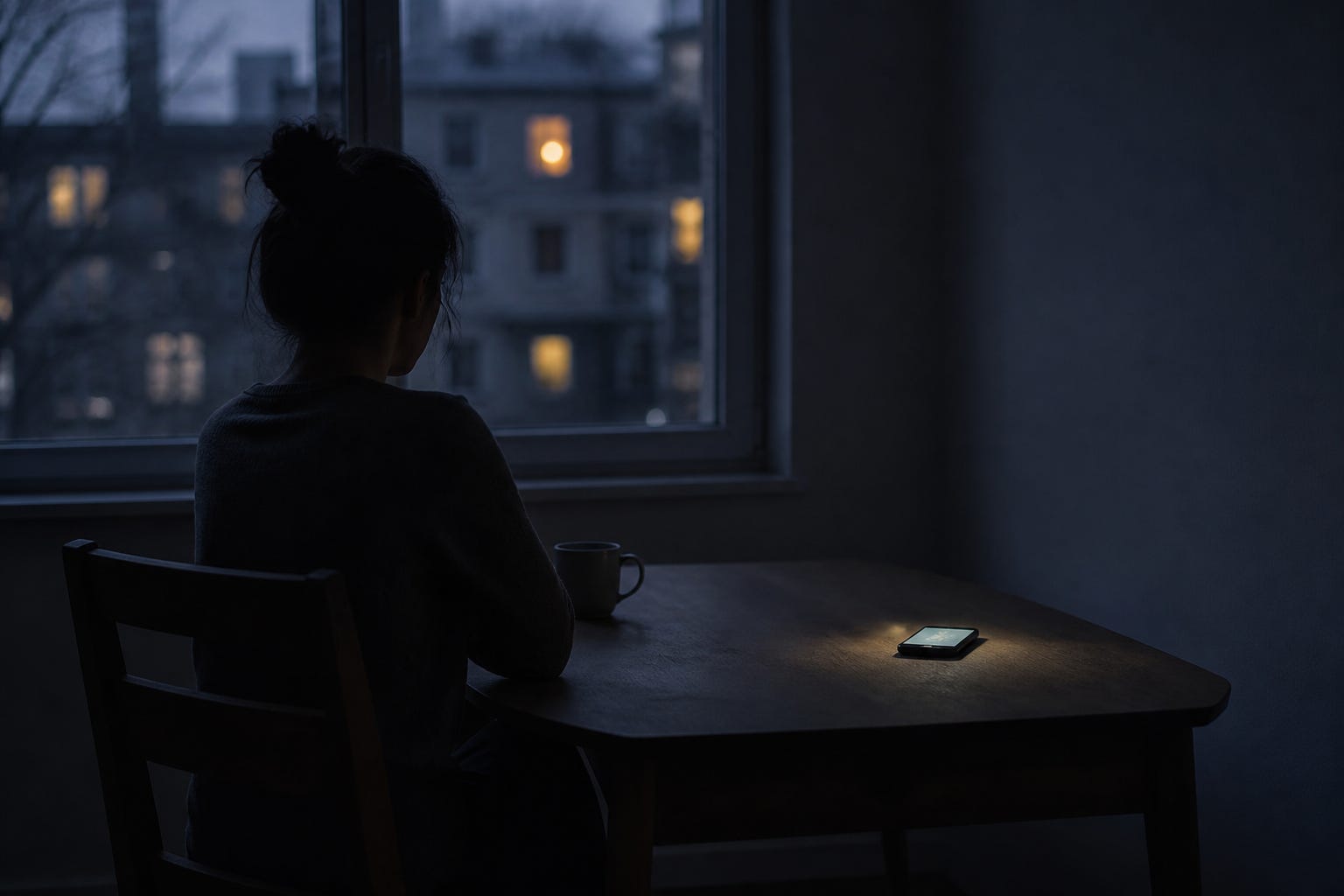
Your phone is rarely more than an arm’s length away. It rests on the nightstand while you sleep, glows in your pocket while you walk, waits face up on the table while you eat. Not because you’re expecting anything urgent. Because the possibility of being reached has quietly become a condition you no longer question.
Somewhere in the last decade, being available stopped being a choice you made for someone in particular and became a baseline you maintain for everyone at once. You reply within minutes. You feel a small pull of guilt when you don’t. You’ve learned, without ever deciding to learn it, that presence now gets measured in reply times instead of in what actually happens once the conversation begins. We have confused being available with being present.
The Myth of the Instant Reply
There was a time when a reply took days, and nobody read the delay as indifference. A letter crossed a country before it reached you, and its slowness was simply the shape distance took, not a verdict on how much you mattered to whoever sent it. A pause of a few hours can read like a verdict now. The faster we’re expected to answer, the less anyone actually asks what we’re being asked to answer for.
Call it connection if you want. I’d call it low-grade vigilance, a background hum of duty that never fully resolves because it was never built to. Work messages, group chats, a friend’s half-finished thought sent at midnight because sending it felt easier than sitting with it alone: each one arrives with an unspoken clock attached. Somewhere we agreed, without a vote, that silence is now something to apologize for.
The Weight of the Green Dot
I’ve done this more evenings than I’d like to admit. Phone lit, thumb still, message read and unanswered, telling myself I’d get to it, some part of me already knowing the getting-to-it had become the whole relationship.
Every platform you use insists on telling the truth about your attention, whether you want it told or not. A small dot, a “last seen,” a “typing...” that appears and disappears: small mechanisms built to remove the plausible deniability that used to protect a private hour. You can’t simply be unavailable anymore. You can only be caught being unavailable, and asked, later, gently or not, where you went.
So you hover. You open the app to see who’s there, then close it without answering, because looking costs nothing and answering costs a version of yourself you don’t have ready yet. You can be watching everyone and reachable by no one, and still call this being social.
I’ve done this more evenings than I’d like to admit. Phone lit, thumb still, message read and unanswered, telling myself I’d get to it, some part of me already knowing the getting-to-it had become the whole relationship.
A Conversation That Never Closes
A conversation used to have a shape. It began, it moved somewhere, it ended, sometimes abruptly, sometimes with the particular satisfaction of a subject fully worked through. Most conversations don’t end anymore. They thin out. A thread stays open for weeks, resumed in fragments between other things, never quite finished because finishing was never really the plan.
You answer a question about dinner, a joke from an old friend, a work request, a photo of someone’s dog, a half-remembered argument from three days ago, all before lunch, all in the same thumb motion, none of it asked for your full attention because none of it expected to receive it. A hundred open conversations can add up to no conversation at all.
The Discipline of Disappearing
Becoming unreachable on purpose now requires an explanation. Turning off a phone for an afternoon needs a plan, a warning, sometimes an apology in advance, as though the default state of being human were interruption and stepping out of it were the strange choice.
Something happens in that hour nobody can reach you. Not despair, though it can start that way. Something closer to remembering that you exist apart from your responsiveness, that you were a person before you became a notification’s intended recipient and you’ll be one after. Unavailability, chosen on purpose, is the closest thing left to a boundary that still means something.
We expect more from technology and less from each other.
— Sherry Turkle, Alone Together
What Presence Actually Costs
Presence is more expensive than availability, and it was never supposed to be cheap. Being truly with someone, not glancing, not half listening while a screen glows nearby, not composing your next reply while they’re still mid-sentence, costs attention you can’t spend twice. Availability, by comparison, is nearly free. It only asks that you keep the door unlocked, not that you actually walk through it toward anyone.
Loneliness is, at its core, a subjective experience—shaped not by how many people you see, but by the emotional depth and meaning of those interactions.
— from Mindfulness for Loneliness
You can spend an entire day in contact with a dozen people and end it having been with none of them.
The Room You’re Actually In
You’re not reading this because you don’t have people to talk to. You’re reading it because some part of you has noticed the specific, quiet exhaustion of being reachable by everyone and met by almost no one, and has started to wonder whether the two are related.
The question was never whether you’re reachable. It’s whether you’re actually there.
Returning to the Person in Front of You
There’s no setting that fixes this. No focus mode, no scheduled downtime, no clever automation that restores presence as a side effect of better software, because presence was never a technical problem. It’s a practice of returning, over and over, to the person or the room or the thought actually in front of you, instead of the dozen elsewhere-conversations pulling at the edge of your attention.
Attention is the only thing you own that was never meant to be spent on everyone at once.
None of this asks you to disappear from the people who matter to you. It asks you to notice the difference between reaching and being reached, between filling the space around you with replies and actually occupying, fully, the smaller space where someone real is standing in front of you. Reachability was supposed to bring us closer. Somewhere along the way, it became the distance itself.
If this distinction feels familiar, if you’ve felt the strange fatigue of being in contact with everyone and close to almost no one, the ebook goes further into what that ache is actually asking of you, and what it looks like to start meeting it.
📘 Mindfulness for Loneliness: Transforming Isolation into Inner Peace
I wonder if constant reachability has changed not only how available we are, but what we expect friendship to feel like.
There was once more room for absence. Someone could be unreachable for a day, a week, sometimes longer, and the relationship did not need continual proof that it still existed. Now silence can feel like neglect. Perhaps one consequence of being able to reach everyone instantly is that we have become less able to trust relationships in the spaces between contact.
Maybe intimacy needs presence, but it also needs enough security to survive absence.