

There is a loneliness that comes from trying to stay gentle in a world that keeps giving you reasons to become hard.
Before Nightfall
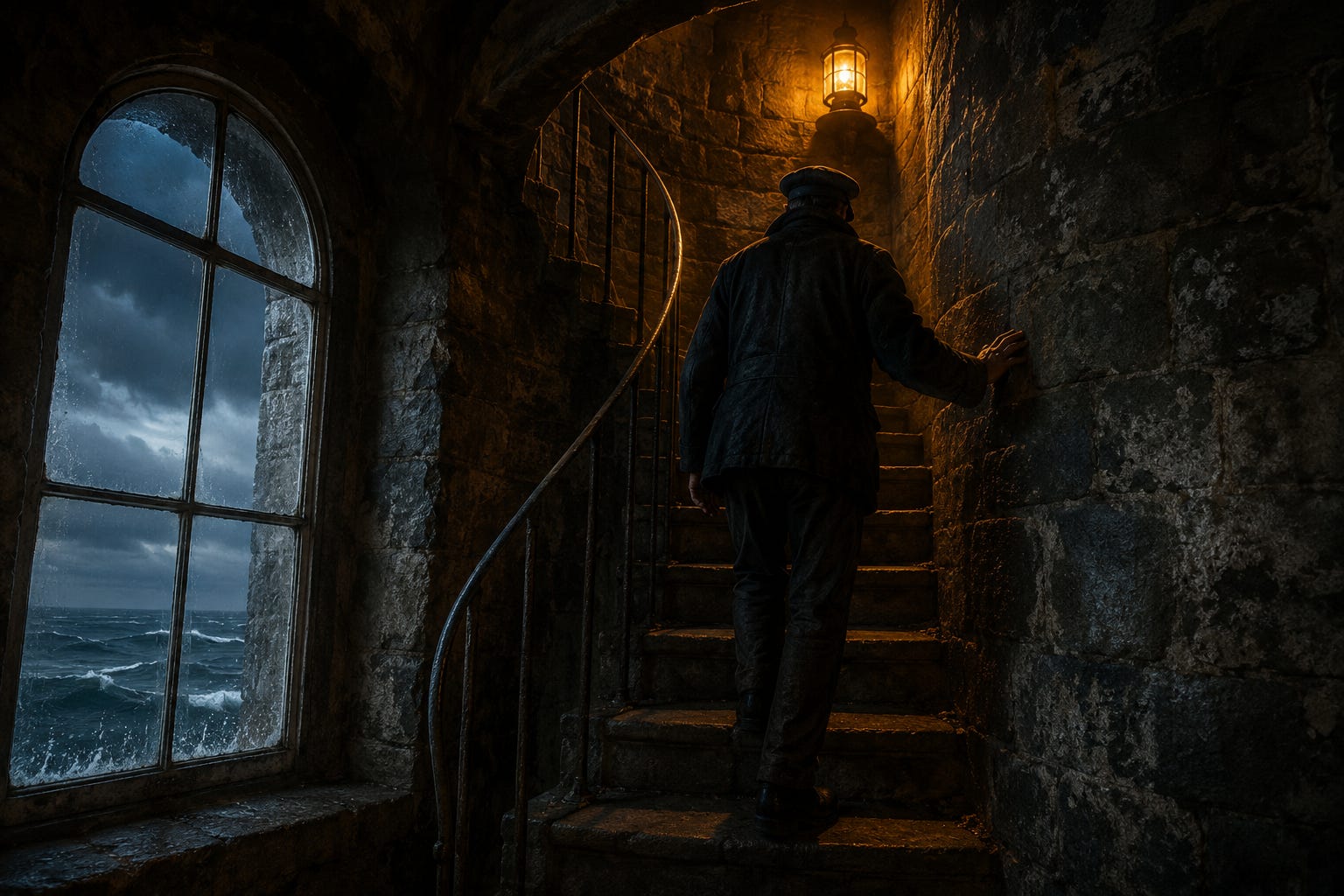
Each evening, before the dark settles over the water, someone climbs the narrow stairs.
The sea below is already restless. Wind presses against the stone. Salt gathers on the glass. Far out, vessels move through distances the shore cannot measure, each carrying its own cargo of hunger, fear, memory, and return. Some will see the light. Some will pass beyond its reach. Some will mistake another brightness for safety. Most will never know whose hand kept the flame visible.
Still, the keeper climbs.
Stone can endure weather for a long time. A flame asks for something more intimate — nearness, attention, someone willing to notice what has dimmed before darkness becomes complete. The tower may stand for centuries. The light survives on smaller fidelities: a hand on the rail, a cloth across the glass, the patient return to what smoke and salt have touched.
The quiet nobility of behavior begins where the world gives us reasons to harden, and something in us still returns to the flame.
The Weather That Enters Us
We enter atmospheres before we understand them.
A family has weather. A school has weather. A workplace, a city, a culture, an age. Some climates teach haste so thoroughly that stillness begins to feel like guilt. Some teach suspicion so early that openness starts to look unsafe. Some teach comparison before the soul has learned how to listen to itself.
At first, we adapt — we learn the tone that protects us, which parts of ourselves can appear safely and which must wait below the surface, how quickly sincerity can be mocked, how easily gentleness gets mistaken for weakness. Hardness arrives with a convincing face. It calls itself experience. It calls itself intelligence. It speaks in the grave voice of realism and tells us to answer the world in the language the world has used with us.
And pain can make this sound true. That is the difficulty of it — the case for hardening is not stupid. It is often built from real evidence, gathered honestly, one disappointment at a time.
A little irony replaces warmth. Suspicion takes the place where openness once stood. Contempt begins to guard a grief that was never actually met. While this is happening, it rarely feels like collapse. It feels like adjustment. It feels like learning how to survive.
Only later, alone, do we notice that the glass has darkened.
When the Glass Darkens
A lighthouse can fail while still standing.
The flame may remain alive, yet salt thickens across the panes. Smoke gathers from within. Dust settles where the hand has stopped returning. From the rocks below, the tower still looks whole. From far away, it may still resemble a place of guidance. Yet what should pass through clearly becomes blurred, weakened, uncertain — and no one out at sea can tell the difference between a light that is failing and a light that never existed.
The same thing happens inside a person.
We may continue to function — speak, work, answer messages, keep appointments, fulfill obligations — while inwardly something once clear becomes obscured. Resentment stains perception. Old humiliation begins to steer new encounters. Fear learns the vocabulary of discernment, and cynicism borrows the clothes of wisdom, until we can no longer tell, from the inside, which one we’re actually using.
This is rarely evil. More often it is neglected pain: weather touched the glass, and no one ever taught us how to clean what weather leaves behind.
There is a particular loneliness in recognizing this — in hearing the old wound in your own tone, feeling it in your suspicion, noticing the small pleasure in withholding warmth before warmth can be withheld from you. That recognition hurts because it reveals more than injury. It reveals inheritance. It tells you that something hurt you once, and has quietly been speaking through you ever since.
The Work No One Sees
The keeper’s work is mostly invisible.
The cleaning of glass attracts no applause. The tending of a flame has little spectacle in it. Few know how often the stairs must be climbed, how often the same small task must be repeated, how ordinary the maintenance of light can appear from the outside — which is exactly why it is so easily misunderstood. We imagine nobility as grandeur: sacrifice, visible courage beneath a bright sky. Most of it is quieter than that. A sentence left unsharpened. A silence that refuses to carry gossip further. A boundary held without contempt. An apology made without an audience. A refusal to make another person carry what we have not yet understood in ourselves.
These gestures leave no evidence. A cruel word unspoken does not enter the record. A humiliation withheld has no monument. A bitterness interrupted before it becomes action will rarely be praised by anyone — because no one but you will ever know it almost happened.
This can feel lonely. The world rewards the storm and forgets the keeper. Noise travels; reaction spreads; cruelty looks powerful because it leaves visible marks. Care works differently. Its trace is the wound that did not deepen, the fear that did not multiply, the person who walked away a little less damaged than they might have been.
Some forms of goodness appear only as absence — a darkness that was not added, a wound that was not passed forward, a small mercy that left no signature anywhere but in the person who chose it.
The Climb Back
The flame is never protected once.
One clear decision cannot keep the glass clean forever. Weather returns. Salt returns. Smoke returns. Old wounds return wearing new clothing — someone says the thing that finds the exact unhealed place, someone’s carelessness wakes an ancient anger, someone’s arrogance tempts us toward the lowest room in ourselves. Then the stairs have to be climbed again.
Mindfulness is close to this climb: the slow return to what has clouded over, the willingness to see what the weather left behind. Envy that arrives disguised as clarity. Fatigue that starts sounding like wisdom. The old wish to withdraw love before it can be withheld from us first.
Silence is often imagined as peaceful. Sometimes it just shows us how clouded the glass has become — the harshness we’ve been justifying, the story we’ve been repeating, how easily the world we condemn begins to live through our own reactions. This seeing can hurt. It can also save us, because what is seen can be cleaned, and what is acknowledged no longer has to steer us from below. The keeper returns because the glass clouds. The work continues because the weather continues. Care becomes real only through repetition — never through a single grand gesture that’s supposed to last forever.
Keeping Faith with the Self
There are seasons when gentleness feels almost unreasonable: to remain honest among people who bend truth for advantage, careful where others are careless, protective of another’s dignity when conflict has made dignity feel inconvenient.
This asks more of us than hardness does. Hardness can be automatic — reaction inherited, contempt moving through a person with terrible ease. A pause asks more. A clean response asks more. We are shaped by what happened to us. We are also shaped by what we choose to protect afterward, and that second shaping is the only one we actually get a vote in.
A noble person knows bitterness well enough to refuse it a home. Recognizes the pull of cruelty without ever kneeling to it, because recognizing a thing and obeying it turn out to be two different acts entirely. Has had every reason, on any given evening, to let the flame go out — and climbs the stairs anyway. This is fidelity: a loyalty to the deeper self that can still be trusted with light, even on the nights when nothing out on the water proves that trust was warranted.
There may be long seasons when no ship appears to notice the light. Long nights when the storm sounds larger than the flame. Long stretches when careful behavior brings no reward except the private knowledge that you did not betray yourself completely. The keeper may never know which vessel changed course because the light stayed visible. May never see the face of the one who avoided the rocks. May never be thanked for a disaster that quietly did not happen.
Still, the light matters. Its meaning is not measured by who noticed.
When the Flame Feels Distant
The storm will come again — more salt on the glass, more nights when the sea sounds larger than the flame, more moments when bitterness offers its cold intelligence and calls it protection. Some of those arguments for hardening will even be true. Pain explains the neglected glass. It does not get authority over whether the flame is abandoned.
Loneliness asks for this same kind of tending. It can feel like dark weather around the self — the world going distant, other people going unreachable, your own warmth going uncertain. In that weather, isolation starts to look less like a condition and more like a fact about who you are. But the flame is still there. It only feels farther away, behind glass that grief, fear, exhaustion, and the ache of not being met have clouded from the inside.
Attention, returned to gently and without force, is what clears it. Not by demanding that the loneliness disappear first, but by keeping company with the part of you that is still alive inside it — the part that is, right now, still tending something, even if no one has told you so in a long time.
If any of this found something in you, it’s the ground Mindfulness for Loneliness: Transforming Isolation into Inner Peace was written to meet — a companion for the nights when the inner flame feels distant, when silence gets heavy, when the return to yourself has to happen slowly, one clouded pane at a time.
Somewhere in this image, the metaphor should stop working as a metaphor. You are not reading about a keeper on some rock far off the coast. You are the one who climbs the stairs inside yourself each evening, entrusted — by no one, relieved by no one — with the one flame you were ever actually given charge over. That was never someone else’s story. It was yours all along, told from just far enough away that you could finally see it clearly enough to trust it.
A flame is not protected once. Neither is a heart.
And when the night gathers again over the water, the task remains simple: rise without drama, place one hand on the old stone wall, and climb. Not because anyone is watching. Because it was left to you. So climb.
📘 Mindfulness for Loneliness: Transforming Isolation into Inner Peace


Thanks for sharing really worth reading article
Just highlighting this part
Mindfulness is close to this climb: the slow return to what has clouded over, the willingness to see what the weather left behind. Envy that arrives disguised as clarity. Fatigue that starts sounding like wisdom. The old wish to withdraw love before it can be withheld from us first.
A flame is not protected once. Neither is a heart.
And when the night gathers again over the water, the task remains simple: rise without drama, place one hand on the old stone wall, and climb. Not because anyone is watching. Because it was left to you. So climb.
Magnificent metaphore/parable, I appreciate the way you stress that nobility is not (always) grandeur, as you wisely write. The patience of the keeper o light is really a model for every day people and yeah, "the flame is still there" no matter what kind of storm is behind the lighthouse/soul, and hope can arise whatever it takes!
I enjoy the fact new posts are more focused on small "stories"/ visual parables. Keep doing this interesting writing, Federico!