

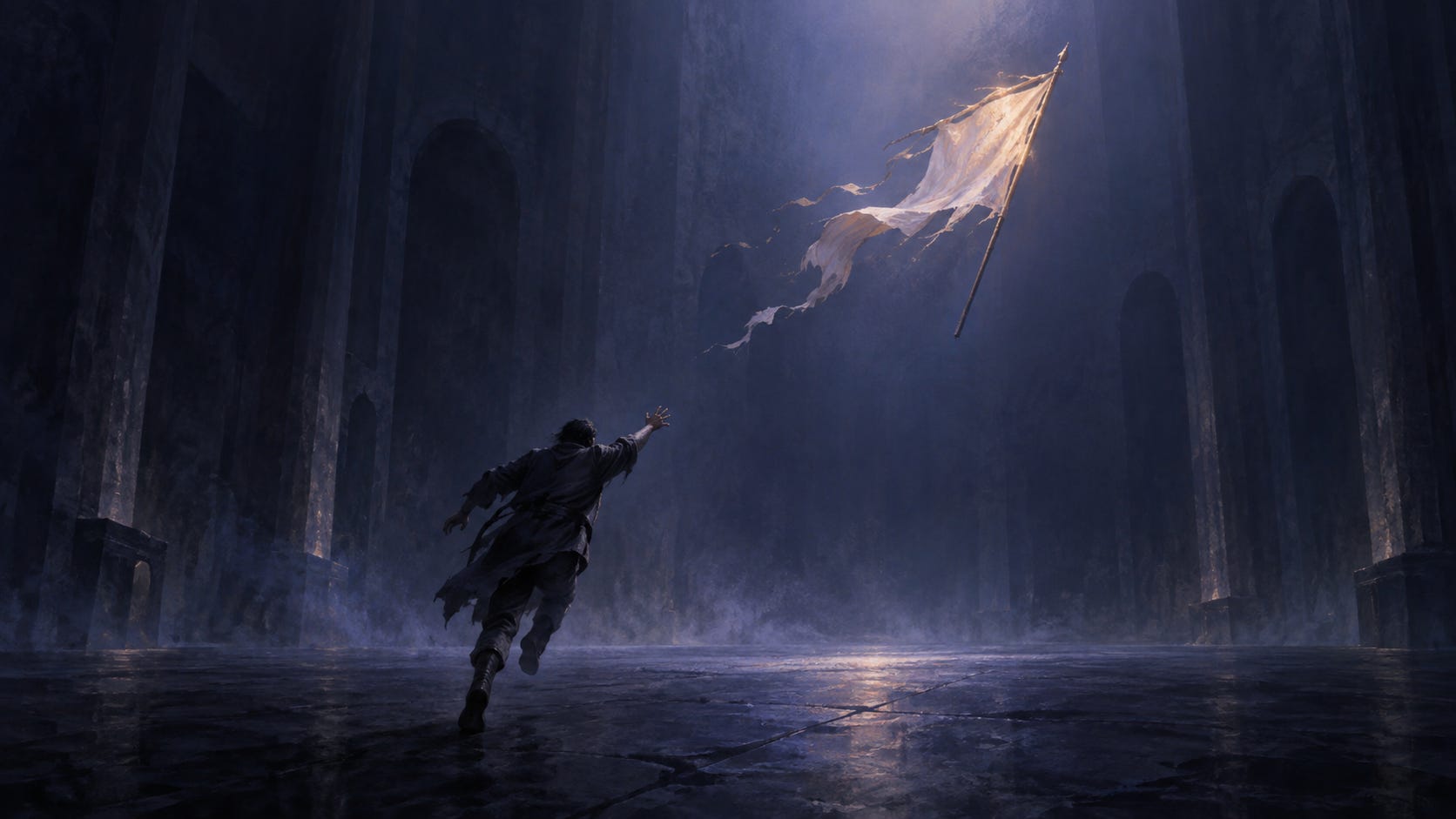
Imagine people living beneath an upper floor they rarely see. From time to time, something foul falls from above and lands among them, disrupting their lives. They are angry, understandably, but instead of looking up, they turn toward one another. Who took too much? Who has the better corner? Who should clean the mess? Before long they are bargaining, accusing, competing, sometimes taking from one another simply to move somewhere less exposed. Then something else falls, and still almost nobody looks up.
There is something of modern society in this image. We have become remarkably skilled at fighting sideways over what falls from above.
The Struggle Below
It is easy to speak of competition from a place of security. For someone comfortable, competition may mean salaries, careers, investments, property or status. Closer to necessity, however, something more primitive comes first: food, rent, debt, safety, tomorrow. When the margin becomes narrow enough, another person’s vulnerability can become an opportunity.
Scarcity does not make people cruel; some of the deepest forms of solidarity emerge among those who possess very little. Yet scarcity can also narrow the horizon. Someone deceives because deception pays, steals because possession has become survival, accepts the bribe, exploits the stranger, or takes the advantage before advantage is taken from them. The tragedy is not only that people may harm one another, but that they can spend their lives struggling horizontally while having little time or energy left to ask why so many are struggling in the first place.
We tend to imagine power vertically: governments above us, corporations above us, concentrated wealth above us. Yet every durable social order also has a horizontal life. It passes between employer and employee, landlord and tenant, creditor and debtor, buyer and seller, and, under greater scarcity, between people competing over the same narrow ground. Horizontal antagonism is harder to see because we are standing inside it.
Jiddu Krishnamurti saw competition and isolation as movements belonging to the same divided way of living:
I am lonely. This loneliness has been brought about by self-centered activity, and that self-centered activity — one of its forms is ambition, greed, envy, competitiveness, imitation.
— J. Krishnamurti, Relationship Without Dependence, public dialogue, Saanen, 1973
His observation moves the problem uncomfortably close. Society is not merely something imposed upon us from somewhere above; it is also recreated through the relationships between us.
Money gives those relationships an extraordinarily efficient language. It allows strangers to cooperate across continents without knowing, trusting or even seeing one another, while translating much of that cooperation into questions of advantage. The landlord wants more while the tenant wants less; the employer wants to contain labor costs while the employee wants higher wages; the seller seeks a greater margin while the buyer seeks a bargain. None of this requires cruelty. Everyone may simply be behaving reasonably from where they stand.
Yet abstraction creates moral distance. The employee becomes labor cost, the tenant becomes yield, the customer becomes revenue, the home becomes an asset. These descriptions hold a partial truth, and mistake it for the whole one. Money moves more than value. It can move consequences far enough away that we cease to feel ourselves participating in them.
Too Busy to Look Up
Struggle also consumes attention. Someone worried about tomorrow’s food, rent, employment or safety has little room left to investigate the architecture producing those pressures. Call it exhaustion rather than ignorance: immediate necessity keeps placing something closer in front of the larger question.
Greater security does not necessarily end this preoccupation. It can simply change its vocabulary. Survival becomes advancement, advancement becomes comparison, and comparison can become accumulation. One person is occupied by not having enough; another by the possibility of never having enough. Those with the least freedom may be too occupied with survival to question the structure, while those with the most freedom may become too invested in it to leave it.
Between them are many who are tired enough to want something different, secure enough to fear disruption, and occupied enough to continue. No conspiracy is necessary for this to preserve a status quo. A system does not need to have been designed to keep people preoccupied in order to benefit from their preoccupation. When something foul falls again, the person beside us remains easier to see than the floor above.
Dante’s Uncommitted
The question changes, however, when necessity begins to loosen its grip.
At the threshold of Hell in the Inferno, Dante encounters the ignavi, a word with no perfect English equivalent. Calling them lazy or indifferent misses the point. Their failure is one of moral non-commitment: they passed through life without meaningfully placing themselves behind good or evil, avoiding both the disgrace of choosing badly and the sacrifice that can accompany choosing well.
Virgil describes them alongside the angels who had refused allegiance to either side:
This miserable state is borne by the sorry souls of those who lived without infamy and without praise. They are mingled with that base choir of angels who were neither rebellious nor faithful to God, but were for themselves.
— Dante Alighieri, Inferno, Canto III, lines 34–39 (author’s translation)
Ma per sé fuoro: they were for themselves.
This is the same isolation Krishnamurti described, wearing a different name. Self-centered activity doesn’t require choosing a side — it only requires that the self remain the center, untouched by relationship, uncommitted to anything beyond its own preservation. Their crime was solitude wearing the mask of neutrality.
The phrase is severe precisely because it does not describe some spectacular evil. We can condemn exploitation, corruption, environmental destruction or institutional abuse sincerely while arranging our lives so that these convictions ask almost nothing of us. There is a peculiar comfort in unspent conviction: belief strong enough to express, but not strong enough to inconvenience us.
What We Feed, What We Leave Hungry
This non-commitment has two sides. The first concerns what we continue to feed. Much participation is unavoidable: taxes are compulsory, people need housing and employment, and almost nobody can withdraw from every compromised institution or trace every consequence of every purchase. Participation is not the same as consent, which is why purity is the wrong standard.
The meaningful question begins where necessity loosens its grip. Where withdrawal is genuinely possible, what are we willing to stop feeding?
But the other side may matter just as much. Somewhere, people are trying to build or preserve something else: exposing what powerful interests would rather keep hidden, protecting a forest, teaching, researching, caring, rescuing, rebuilding, or simply giving part of a life to work whose worth cannot be expressed entirely through financial return. We may admire such work and insist that it matters, yet leave somebody else to sustain it.
The system is sustained twice: by what we cannot or will not withdraw from what we condemn, and by what we refuse to commit to what might improve it.
Generosity doesn’t buy innocence, and no cause deserves support simply for existing. What it does mean is that resources are also agency. Money beyond necessity is also a form of agency: some capacity, however limited, to make one possibility stronger than another. What we believe lives partly in what we are willing to sustain.
The Banner of More
Responsibility cannot be equal because freedom is not equal. The person choosing between food and rent cannot reasonably be judged by the same measure as someone whose material security is assured. Wealth doesn’t automatically imply guilt. It enlarges the territory in which genuine choice becomes possible.
We accumulate partly because we want freedom from precarity, dependence and the fear of having no alternatives. Then, if we are fortunate, some of that freedom arrives, and something curious can happen: instead of asking what the freedom is for, we use it to acquire still more.
Only after judging the ignavi for their refusal to commit does Dante devise their punishment. Having followed no meaningful standard in life, they must run endlessly after a banner that never settles. Our own banner may be less dramatic. It may simply read more.
For someone in poverty, more may mean survival; later it may mean security, then comfort, then status, until eventually the pursuit continues without any very clear destination. There is nothing wrong with seeking security. The deeper problem begins when security arrives but the movement cannot stop, because stopping would leave us facing a question accumulation cannot answer: What for?
Perhaps this is the quietest trap of accumulation: more postpones enough, and without enough, we never have to answer what for. The person with very little may truthfully say, I cannot afford to choose yet. The person with almost everything can spend a lifetime saying the same. The banner keeps moving.
Looking Up
There is no pure place outside all of this. We will remain contradictory, participate in things we dislike, and fail to live completely according to what we believe. The question that matters is simpler: can we still recognize where necessity ends and choice begins?
This is where mindfulness can mean something more than private calm. It does not tell us which ideology to follow or which cause deserves our support. It creates enough space to look up: to notice what keeps falling, when we have begun fighting the person beside us instead, what we continue to feed because we truly must, and what we continue to feed because changing would cost us something. It may also reveal what we claim should exist while leaving somebody else to sustain it.
Perhaps the most durable systems are not those we believe in, but those we have learned to oppose without ever choosing against them. Our continued participation is enough to keep them standing. Faith was never required.
And perhaps the deepest question comes when the struggle finally loosens its grip: if the struggle ended for us tomorrow, would we know what to do with the freedom it left behind?
At some point, conviction has to leave the safety of thought. What we stand for becomes visible in what we are willing to sustain.
There is a quieter version of this same looking up: noticing what becomes visible when the noise settles enough to see what has been carrying us. Mindfulness for Loneliness explores that territory — loneliness, presence, our relationship with ourselves — as a companion for seeing more clearly what is already there.
📘 Mindfulness for Loneliness: Transforming Isolation into Inner Peace
Sources referenced
J. Krishnamurti, Relationship Without Dependence, 3rd Public Discussion, Saanen, August 3, 1973. Transcript: krishnamurti.org
Dante Alighieri, Inferno, Canto III, lines 34–39. The rendering above is the author’s own translation; the Italian original and standard English translations are widely available.


That's Reflective Article
Thanks for sharing and keep writing 💫
Just highlighting this part
Survival becomes advancement, advancement becomes comparison, and comparison can become accumulation